論文情報(Publication Information): Hiratsuka Y, Hamano J, Mori M, Aoyama M, Morita T, Tsuneto S, Miyashita M. Discussion About Life Expectancy and Functional Prognosis in Family Members of Cancer Patients. J Pain Symptom Manage. 2026 Jul;72(1):68-74. doi: 10.1016/j.jpainsymman.2026.03.009.
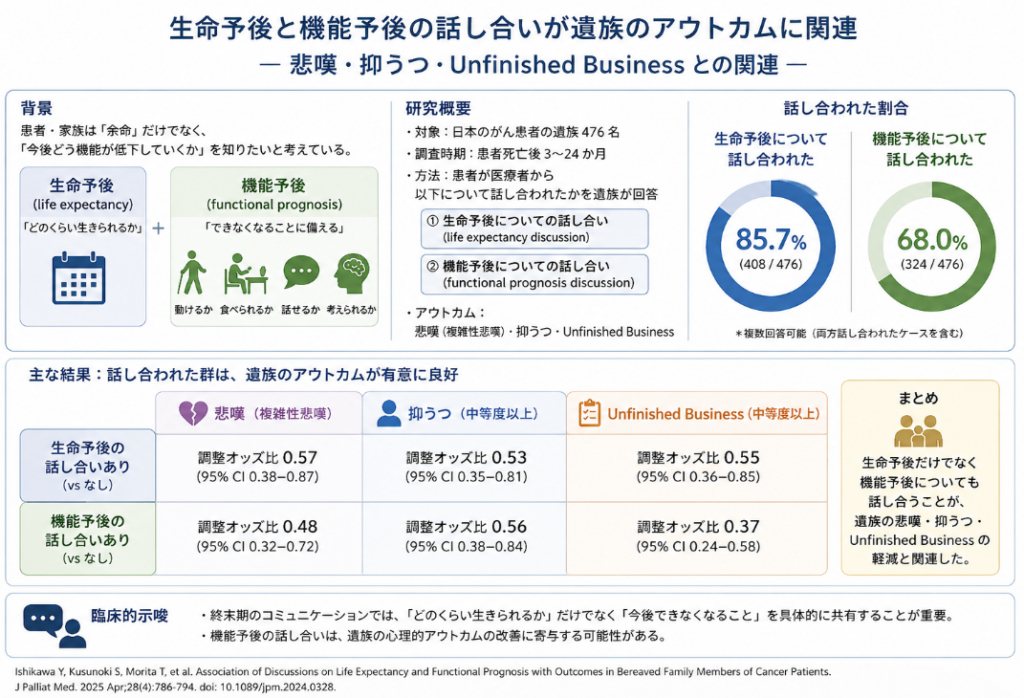
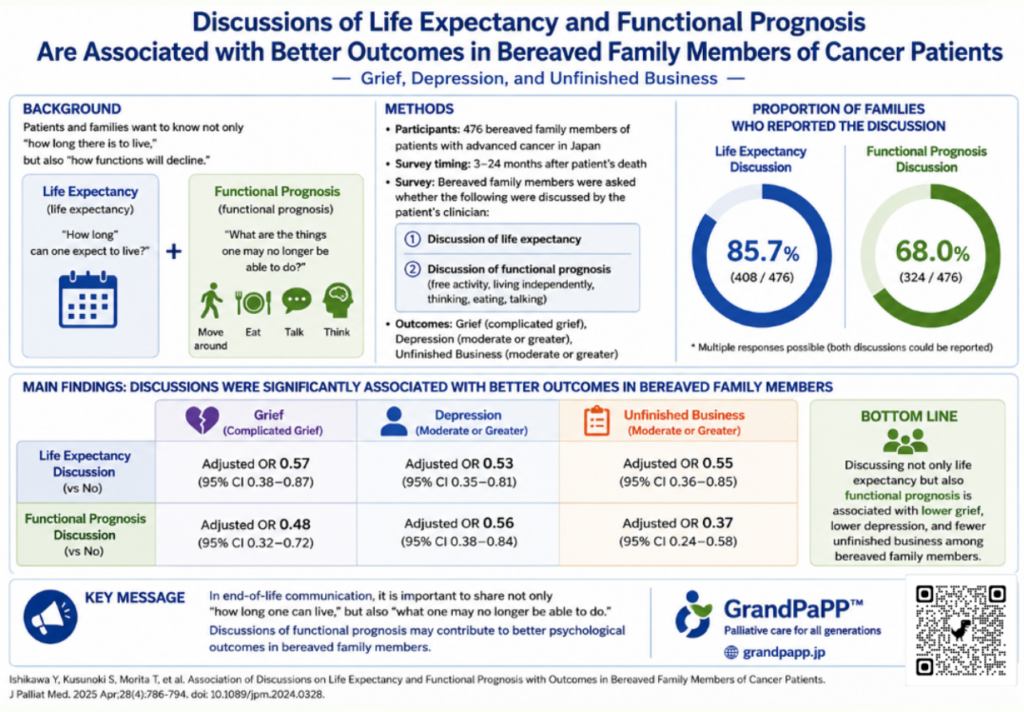
Beyond simply discussing life expectancy, sharing what patients may gradually lose the ability to do in the future may help reduce bereaved families’ grief, depression, and feelings of “unfinished business.”
In this nationwide Japanese study analyzing 582 bereaved family members from palliative care units, families who had discussions about:
life expectancy
functional prognosis (such as mobility, eating, thinking, and communication)
showed consistently better outcomes in:
BGQ (complicated grief)
PHQ-9 (depression)
UBS-F (unfinished business)
However, this was an observational study, and major confounders likely existed, including communication culture and the degree of ACP practice.
Therefore, the study cannot conclude that prognostic discussions themselves directly improved outcomes.
Still, the administrator agrees that:
“How we communicate functional prognosis”
is an important issue in real-world palliative care practice.
Bereaved family members of cancer patients who died in palliative care units.
Pre-planned analysis of a nationwide bereavement survey (J-HOPE 5 study).
Eligibility criteria:
Patients who died of cancer in participating palliative care units between February 1, 2022, and January 31, 2024.
Patient age: ≥20 years
Bereaved family member age: ≥20 years
Exclusion criteria:
Death within 3 days after admission to the palliative care unit
Bereaved family members who could not be identified or contacted
Bereaved family members judged by physicians or nurses to have severe psychological distress
Participants unable to complete self-administered questionnaires because of cognitive impairment, visual impairment, etc.
Patient characteristics:
Mean age: 77.6 years
All patients died in palliative care units.
Most family members were children or spouses.
━━━━━━━━━━
I (Intervention)
Intervention:
Discussions regarding:
“Life expectancy” and “Functional prognosis”
between the patient’s clinicians and family members.
Content of functional prognosis discussions:
Mobility/free activity
Independent living
Thinking/cognition
Eating
Conversation/communication
Dose, duration, timing:
Not a drug intervention; therefore, no dosing was applicable.
Participants answered retrospectively regarding the entire clinical course until the patient’s death.
The specific number, timing, and duration of discussions were not reported.
Evaluation:
Rather than a true intervention study, this was an observational study evaluating the presence or absence of prognostic communication as an exposure.
━━━━━━━━━━
C (Comparison)
Comparison groups:
Life expectancy discussions
With discussion
vs
Without discussion
Functional prognosis discussions
With any functional prognosis discussion
vs
Without discussion
Validity of comparison:
The comparison has some validity.
However:
No randomization
Observational design
Potential confounding by:
relationship quality
disease severity
institutional culture
Therefore, it cannot be concluded that the discussions themselves caused improved outcomes.
In particular, the discussion group may have included more:
medical teams with better communication skills
families with more advanced ACP involvement
families with better baseline coping abilities
━━━━━━━━━━
O (Outcome)
Primary outcome:
No clearly defined “primary outcome” was specified.
Outcomes actually evaluated:
Complicated grief
Brief Grief Questionnaire (BGQ)
Depression
PHQ-9
Unfinished business
UBS-F
Results:
The discussion groups showed lower:
grief
depression
unfinished business
Importance to patients/families:
These are highly important outcomes.
In particular:
bereavement grief
depression
unfinished business
are clinically critical outcomes in palliative and end-of-life care.
Importantly, the study evaluated:
“psychological outcomes of bereaved family members”
rather than simple satisfaction measures.
━━━━━━━━━━
Clarity of the PICO and Clinical Applicability
━━━━━━━━━━
The clinical question is relatively clear.
In particular:
“Is there value not only in discussing life expectancy, but also in discussing future functional decline?”
is directly relevant to real-world palliative care practice.
The study focused on changes families actually struggle with, such as:
becoming unable to eat
becoming unable to move
becoming unable to speak
which makes the study highly clinically relevant.
On the other hand, major limitations include:
observational design
inability to establish causal inference
lack of standardization of discussions
unclear timing of discussions
Therefore, the study cannot determine exactly how prognostic information should be communicated.
Nevertheless, the study strongly suggests that:
“Discussing functional prognosis may be important as part of family care.”
━━━━━━━━━━
Internal Validity Assessment Using ROBINS-I
Because this study was an observational pre-planned analysis of a nationwide bereavement survey rather than a randomized controlled trial, ROBINS-I (Risk Of Bias In Non-randomized Studies – of Interventions) is more appropriate than RoB 2.
━━━━━━━━━━
Bias due to confounding ━━━━━━━━━━
Judgment: Serious risk
Rationale:
Participants were naturally divided according to whether:
life expectancy discussions occurred
functional prognosis discussions occurred
No randomization was performed.
Major uncontrolled confounders include:
communication skills of the medical team
ACP culture
family relationships
baseline psychological resilience
understanding of illness
disease severity
family preferences
These factors could influence both:
whether discussions occurred
and
bereavement outcomes
This represents the greatest limitation of the study.
━━━━━━━━━━
Bias in selection of participants ━━━━━━━━━━
Judgment: Serious risk
Rationale:
Response rate: 58.9%
Complete case analysis performed
Bereaved family members with severe psychological distress were excluded
Concerns:
Families with severe grief or difficulty responding may have been excluded.
Differences between responders and non-responders are unknown.
Selection bias is therefore likely.
━━━━━━━━━━
Bias in classification of interventions ━━━━━━━━━━
Judgment: Moderate risk
Rationale:
Presence or absence of discussions was based on self-report by bereaved family members.
Concerns:
The meaning of “discussion” was ambiguous.
Specific content unknown
Frequency unknown
Timing unknown
Potential misclassification may therefore exist.
━━━━━━━━━━
Bias due to deviations from intended interventions ━━━━━━━━━━
Judgment: Moderate risk
Rationale:
No standardization of discussions was reported.
Concerns:
Explanation content
Who conducted discussions
Family understanding
Other psychological support
were not controlled.
The findings may therefore reflect overall communication quality rather than the discussions themselves.
━━━━━━━━━━
Bias due to missing data ━━━━━━━━━━
Judgment: Serious risk
Rationale:
Missing responses existed.
Complete case analysis was used.
Concerns:
Missingness may not have been random.
Families with greater psychological distress may have been less likely to respond.
━━━━━━━━━━
Bias in measurement of outcomes ━━━━━━━━━━
Judgment: Moderate risk
Rationale:
Validated scales were used:
BGQ
PHQ-9
UBS-F
Concerns:
Retrospective self-report
Assessment performed 2–25 months after bereavement
Recall bias may therefore exist.
━━━━━━━━━━
Bias in selection of the reported result ━━━━━━━━━━
Judgment: Some concerns
Rationale:
The study was described as a “pre-planned analysis.”
Concerns:
Insufficient protocol detail
No clearly defined primary outcome
No multiplicity adjustment reported
Selective reporting therefore cannot be fully excluded.
Thus, the study has substantial clinical value as a hypothesis-generating study suggesting that:
“Discussion of functional prognosis may be important in bereaved family care.”
━━━━━━━━━━
Importance of the Results: Evaluation Based on JAMA Users’ Guides “What are the results?”
Magnitude of effect
No clearly defined primary outcome was reported.
Main outcomes evaluated included BGQ, PHQ-9, and UBS-F.
Life expectancy discussion group vs no discussion group:
BGQ: 4.03 vs 5.04 Mean difference: 1.01
PHQ-9: 4.39 vs 5.92 Mean difference: 1.53
UBS-F total score: 42.12 vs 47.55 Mean difference: 5.42
Functional prognosis discussion group vs no discussion group:
BGQ: 3.91 vs 4.78 Mean difference: 0.86
PHQ-9: 4.08 vs 5.76 Mean difference: 1.68
UBS-F total score: 41.57 vs 46.20 Mean difference: 4.63
Interpretation:
All outcomes favored the discussion groups, with lower grief, depression, and unfinished business.
Clinical significance:
Although the effect sizes were not large, the consistent improvement across psychologically important bereavement outcomes is clinically meaningful.
Precision based on 95% confidence intervals
Life expectancy discussions:
BGQ mean difference: 1.01 (95% CI 0.42–1.59)
PHQ-9 mean difference: 1.53 (95% CI 0.23–2.84)
UBS-F total score mean difference: 5.42 (95% CI 2.03–8.82)
Functional prognosis discussions:
BGQ mean difference: 0.86 (95% CI 0.44–1.29)
PHQ-9 mean difference: 1.68 (95% CI 0.71–2.64)
UBS-F total score mean difference: 4.63 (95% CI 2.10–7.16)
Interpretation:
Confidence intervals did not cross zero, suggesting relatively consistent directionality.
Clinical significance:
However, because this was an observational study, these estimates should not be interpreted as precise causal effects.
Clinical significance rather than statistical significance
The study reported lower grief, depression, and unfinished business in the discussion groups.
Interpretation:
The PHQ-9 differences of approximately 1.5–1.7 points may not represent a clearly meaningful clinical difference at the individual level.
However, they may still be meaningful at the population level.
Clinical significance:
In particular, reduction in unfinished business is important in palliative care because it is closely related to the quality of end-of-life communication.
Absolute risk reduction, relative risk, NNT/NNH
The primary analyses involved comparisons of continuous scale scores rather than event rates.
Therefore:
Absolute risk reduction: Not calculable
Relative risk: Not calculable
NNT/NNH: Not calculable
Clinical significance:
The findings cannot be translated into statements such as: “How many families need prognostic discussions to prevent one case of severe grief.”
Balance of benefits and harms
Potential harms of prognostic discussions were not evaluated.
Clinical significance:
While prognostic discussions may potentially increase anxiety or emotional burden, this study cannot determine the balance between benefit and harm.
Consistency between outcomes
BGQ, PHQ-9, and UBS-F all consistently favored the discussion groups.
Interpretation:
The direction of findings was consistent.
Clinical significance:
Not only life expectancy discussions, but also functional prognosis discussions may be associated with better psychological outcomes among bereaved family members.
Is this important enough to change practice?
This study alone cannot causally conclude that prognostic discussions improve bereavement outcomes.
However, the finding that discussing functional prognosis — such as whether the patient may still be able to move, eat, or speak — was consistently associated with lower grief, depression, and unfinished business is clinically important.
This is not a practice-changing randomized trial, but it provides useful hypothesis-generating evidence supporting greater attention to functional prognosis discussions in palliative care practice.
━━━━━━━━━━
External Validity: Three Questions from JAMA Users’ Guides
Are the patients similar to those in one’s own clinical setting?
Rationale:
Participants were bereaved family members of cancer patients who died in Japanese palliative care units.
Mean patient age: 77.6 years
Mean family age: 62.9 years
Most family members were spouses or children.
Considerations for Japanese general hospitals:
The population is relatively similar to Japanese palliative oncology settings.
However, the study included only patients hospitalized in palliative care units for ≥4 days.
Therefore, extrapolation to:
general wards
ICUs
outpatient settings
home care
sudden deterioration/death
should be done cautiously.
Should practice change?
Not through major institutional reform, but it may encourage clinicians to discuss not only life expectancy but also functional prognosis with families.
Were all clinically important outcomes considered?
Rationale:
Evaluated outcomes included:
complicated grief (BGQ)
depression (PHQ-9)
unfinished business (UBS-F)
All are clinically important bereavement outcomes.
Considerations for Japanese general hospitals:
Important bereavement outcomes were evaluated.
However, the study did not adequately assess:
patient anxiety
hope
illness understanding
trust in clinicians
potential harms of discussions
family satisfaction
healthcare resource utilization
Should practice change?
There is value in reconsidering prognostic communication from the perspective of potentially reducing grief and regret among bereaved families.
However, communication does not automatically lead to positive outcomes.
Do the benefits outweigh the harms and costs?
Rationale:
Groups with life expectancy and functional prognosis discussions consistently showed better BGQ, PHQ-9, and UBS-F scores.
However, psychological harms of discussions were not directly evaluated.
Considerations for Japanese general hospitals:
Costs mainly involve:
time
communication skills
team coordination
No medications or devices are required.
However, inappropriate communication may increase anxiety or hopelessness.
Therefore:
ACP
nurse participation
stepwise communication
are desirable.
Should practice change?
This is a low-cost and feasible intervention.
However, rather than mechanically disclosing prognosis, a more realistic approach is to discuss:
“What the patient may gradually become unable to do”
in accordance with the family’s readiness and coping ability.
Can this be applied tomorrow?
Yes.
However, the goal is not simply to “clearly disclose life expectancy.”
Rather, a reasonable approach is to gradually share information that helps families prepare for changes such as:
mobility
eating ability
speech
consciousness
Although this paper does not provide strong causal evidence sufficient to dramatically change clinical policy, it does provide useful support for modest improvements in palliative care communication practice in general hospitals.
原文は Supportive Care in Cancer, 34:527, 2026年5月9日発表 Factors influencing information overload among breast cancer patients in the information explosion era: a cross-sectional study
JAMA Users’ Guides to the Medical Literature のフレームワークに準拠した日本語まとめ⇓