一行紹介→患者本人が拒否している治療を、それでも行うべきか――その倫理的・実践的判断を整理したガイド。 ————————————————– -What If Cancer Is Diagnosed During Pregnancy?-
Research (Open Access)
Cancer Diagnosed During Pregnancy: A Qualitative Study of Psychosocial Experiences During Treatment and Survivorship Jenny Harris et al. (April 23, 2026)
■ Conclusion
Women diagnosed with cancer during pregnancy may experience substantial psychological, physical, and practical burdens while simultaneously undergoing treatment, childbirth, and parenting.
At the same time, the study suggests that appropriate support systems and coordinated medical care may help reduce these burdens.
👉 Integrated multidisciplinary support is essential.
■ Study Overview
Interview study involving 20 women in the United Kingdom
Experiences from pregnancy through the postpartum period were analyzed
Focused on psychological and social challenges
■ Six Major Themes Identified
① Treatment Amid Uncertainty
Pregnancy may limit diagnostic testing and treatment options.
Patients may experience anxiety about the future.
② Difficulty in Decision-Making
Treatment, delivery, and breastfeeding decisions often overlap.
Patients may need to make decisions with limited information.
③ Balancing Pregnancy and Parenting
Managing hospital visits, treatment, and childcare can be highly demanding.
In some cases, treatment begins soon after delivery.
④ Work and Financial Burden
Some patients experience leave from work or loss of income.
Medical visits and childcare may also increase financial strain.
⑤ Emotional Impact
Patients may experience anxiety, confusion, and emotional conflict.
Many struggle with balancing “what should be a joyful pregnancy” and serious illness.
⑥ Support and Recovery
Some patients experience feelings of isolation.
Although anxiety may persist after treatment, some aspects gradually become easier to process over time.
■ What This Study Suggests
Cancer during pregnancy represents a uniquely challenging situation.
Support should address not only medical care, but also psychological and practical needs.
The timing and style of support should remain flexible.
■ Clinical Implications
Careful information sharing and decision-making support
Collaboration among obstetrics, oncology, and mental health professionals
Support systems involving family members
Continued follow-up after treatment
■ One-Line Summary
👉 Creating an environment where patients do not have to carry everything alone is essential.
—Updated Apr 20, 2026————————————————–
“Differences in Opinion Among Medical Staff”
Disagreement Is Not About Winning or Losing: How Consulting Physicians Manage Conflicts in Serious Illness Care
Disagreement Is Not About Winning or Losing: Managing Conflict Among Consultants in Serious Illness Care Japanese summary link and original article link available on this site
—Updated Apr 19, 2026————————————————–
“Use of Medical Assistance in Dying Among Young Patients in Canada”
JAMA Oncology
Published Online: April 16, 2026 doi: 10.1001/jamaoncol.2026.0700
Original Investigation
Medical Assistance in Dying (MAID) Among Adolescents and Young Adults With Cancer
Emilie Muth, MN; Nicole Maseja, BA; Andrew Harper, MSc; et al.
MAID Use Among AYA Cancer Patients
■ Key Points
Symptom burden increased during the final year of life
Rapid worsening occurred approximately 5 months before death
Palliative care referral was often late (half received palliative care within 3 months before death)
■ Findings
Main symptoms included fatigue, pain, and worsening well-being
In 80% of cases: 👉 “Unable to engage in meaningful activities”
Background factors included:
Social isolation
Desire for control
Acceptance of death
■ Conclusion
👉 Early palliative care referral should be triggered by advanced cancer diagnosis or symptom worsening.
■ Clinical Implications
Distress in AYA patients involves: 👉 Symptoms + “loss of meaning”
→ Opportunities for intervention may exist much earlier.
Quality of Care for Young Adults With Cancer at the End of Life Eduardo Bruera, MD
JAMA Oncology (published online April 16, 2026) doi:10.1001/jamaoncol.2026.0489
Muth et al. reported a retrospective cohort study of AYA cancer patients who received Medical Assistance in Dying (MAID) in Alberta, Canada.
The study included all cancer patients aged 15–39 years who underwent MAID between 2021 and 2022. Through comprehensive cancer registries and a universal healthcare system, detailed data from 34 patients (aged 18–44 years) were collected.
👉 29% had children.
🎯 Clinical Implication
MAID decision-making among AYAs may involve family context, especially children.
This is not simply an “individual choice,” but a relational decision-making process.
From a palliative care perspective: → Structured support for decision-making (family and social context) is important.
Research article — First published Apr 2, 2026
Fast Facts and Concepts #531: Treatment Against the Patient’s Wishes — A Guide for Clinicians and Surrogate Decision Makers
Calvin Gross MD, MTS / Robert Arnold MD
One-line summary → A guide organizing the ethical and practical considerations regarding whether treatment should still be provided when the patient personally refuses it.
原文は Supportive Care in Cancer, 34:527, 2026年5月9日発表 Factors influencing information overload among breast cancer patients in the information explosion era: a cross-sectional study
JAMA Users’ Guides to the Medical Literature のフレームワークに準拠した日本語まとめ⇓
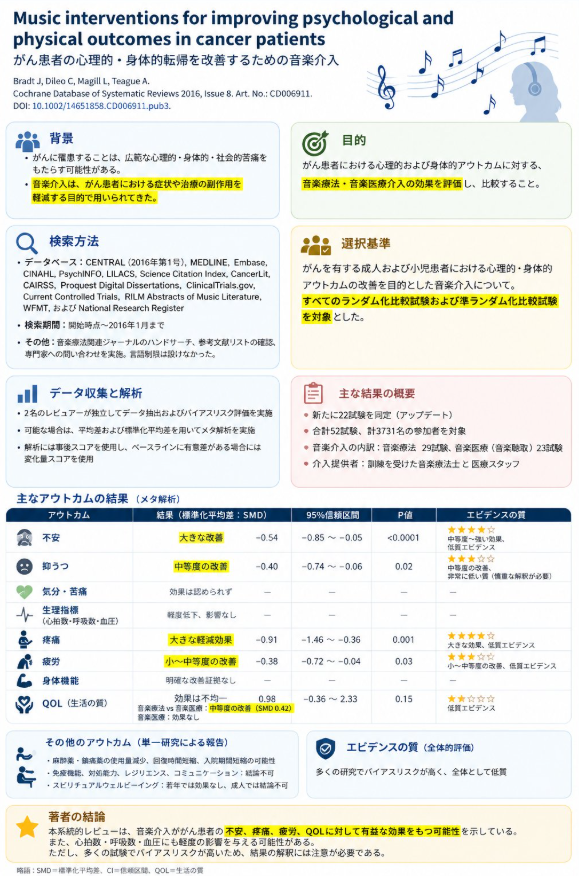
I happened to introduce this topic at our journal club last week, and I truly feel that music has tremendous potential.
At present, in hospitals and palliative care wards, music is often regarded mainly as entertainment, comfort, or recreation. However, there are also well-designed studies that have properly evaluated its effects.
The paper introduced at the journal club was:
“Music interventions for improving psychological and physical outcomes in cancer patients.”
I will leave the details to the original article, but after broadly reviewing and analyzing many studies, the authors found:
a large reduction effect on pain
a moderate to large improvement effect on anxiety
a small to moderate improvement effect on fatigue
One particularly interesting finding was that, regarding improvement in quality of life (QOL), recorded music alone did not show a clear benefit, whereas interventions involving live music performed by trained music therapists did show improvement.
I feel that live instrumental performance carries something that cannot simply be downloaded through the internet — the performer’s feelings toward the listener, the subtle sense of breathing, and the resonance that fills the entire space all at once.
Precisely because we live in an era dominated by the internet and AI, “music performed by humans, healing other humans” may become even more important.
As research and academic interest continue to grow, and as more people become involved in this field, we may eventually reach a time when music interventions in hospitals become a routine part of standard care.
Right now, through a collaboration with a local music school with whom I have a meaningful connection, I hope to explore various new possibilities together.
Link to the paper introduced at the journal club ↓