この論文が検索結果に表示された理由となる箇所は、Keyword欄および本文中でハイライト表示されます。
(The content that matched your search query is highlighted in the Keyword section and/or within the article below.)
この論文が検索結果に表示された理由となる箇所は、Keyword欄および本文中でハイライト表示されます。
(The content that matched your search query is highlighted in the Keyword section and/or within the article below.)
この論文が検索結果に表示された理由となる箇所は、Keyword欄および本文中でハイライト表示されます。
(The content that matched your search query is highlighted in the Keyword section and/or within the article below.)
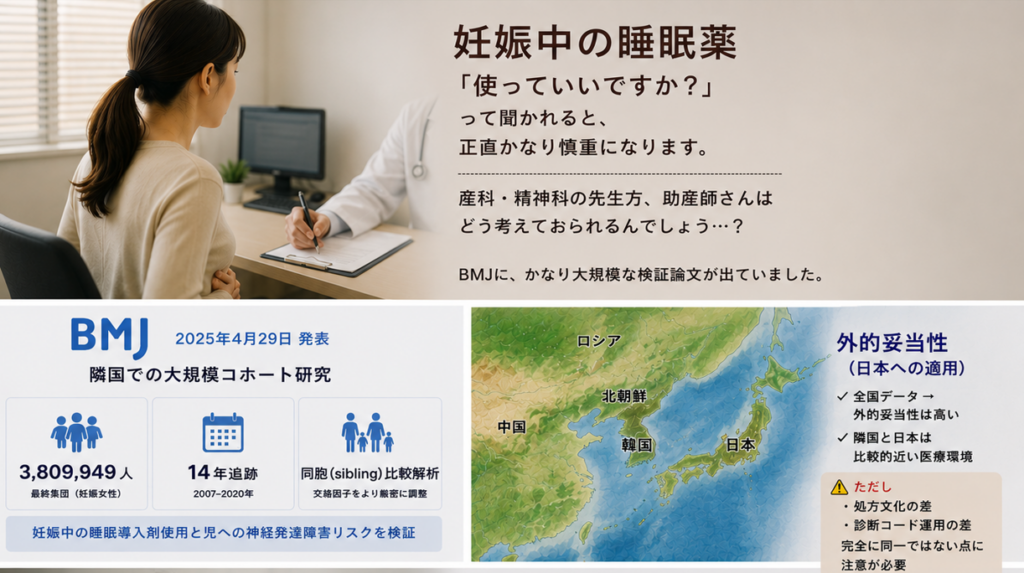
妊娠中の睡眠薬 「使っていいですか?」 って聞かれると、正直かなり慎重になります。
精神科、産科、助産師さんはどう考えておられるんでしょう…?
BMJに、かなり大規模な検証論文が出ていました。
以下論文を紹介する前に、公的機関のリンクもお示しいたします。
主治医への相談が基本ですが、
妊娠中の薬剤使用については、専門相談窓口も存在します。
Research
妊娠中のベンゾジアゼピン系薬またはZ薬使用と、児の精神疾患リスク:人口ベースコホート研究
Benzodiazepine or Z-hypnotic use during pregnancy and risk of psychiatric disorders in children: population based cohort study
BMJ 2026; 393 doi: https://doi.org/10.1136/bmj-2025-088671 (Published 29 April 2026)
Cite this as: BMJ 2026;393:e088671
👉 見かけのリスク上昇は“薬の影響”ではなく、母体背景(精神疾患・家族要因)で説明される可能性が高い
👉 ただし、妊娠後半曝露・長期使用(特にZ薬)は“ゼロリスクではない”
👉 結論:過度な薬剤忌避は和らげてよいが、漫然投与は支持されない
妊娠中は「胎児への影響が分からないものは避ける」という意識が強い領域です。
一方で、不眠は実際に多く、薬剤使用も一定数存在します。
本研究は、その「避けるべきか?」という臨床的疑問に対する検証です。
韓国NHIDデータベース
2010年4月1日〜2022年12月31日に出生した全生児
追跡:出生〜2023年末(最大約14年)
除外:
最終集団:n = 3,809,949
妊娠中に1回以上の処方
(ベンゾジアゼピン / Z薬)
曝露解析:
※用量は評価なし
① 非曝露群
② 過去使用群
③ 同胞比較(兄弟内比較)
👉 段階的に交絡を制御する設計
主要:全精神疾患(ICD-10 F)
副次:
👉 臨床的に重要なアウトカム
👉 Moderate
👉 調整でリスク消失
信頼区間は比較的狭い
👉 大きなリスク増加は否定的
13歳時点:
👉 ただし未調整値のため因果解釈不可
個別アウトカムでも同胞解析でリスク上昇なし
👉 主要結果と一致
👉 軽度上昇傾向(有意差なし)
ただし
👉 完全同一ではない
👉 「使うべき/使うべきでない」ではなく
👉 未治療の母体症状 vs 薬剤リスクの比較材料
👉 見かけのリスク上昇は交絡で説明される可能性が高い
👉 ただし後期・長期使用は注意
👉 過度な忌避は不要、慎重使用が妥当
Research
Use of Benzodiazepines or Z-Hypnotics During Pregnancy and Risk of Psychiatric Disorders in Children: A Population-Based Cohort Study
Original article link
BMJ 2026;393 doi: https://doi.org/10.1136/bmj-2025-088671
(Published 29 April 2026)
Cite this as: BMJ 2026;393
Final Summary (GrandPaPP Perspective)
👉 The apparent increase in risk is likely explained not by the medications themselves, but by maternal background factors such as psychiatric illness and family-related confounding.
👉 However, exposure during late pregnancy and long-term use (particularly Z-hypnotics) cannot be considered entirely risk-free.
👉 Conclusion: Excessive fear of medication use during pregnancy may be unnecessary, but routine or prolonged prescribing is not supported.
Administrator’s Perspective
Pregnancy is a field in which there is naturally strong concern about avoiding anything with uncertain fetal effects.
At the same time, insomnia is actually common, and medication use is not rare in clinical practice.
This study attempts to address the important clinical question:
“Should these medications truly be avoided?”
PICO Summary (Fact-Based)
P (Patient)
Korean NHID database
All live births between April 1, 2010 and December 31, 2022
Follow-up: birth through the end of 2023 (up to approximately 14 years)
Exclusions:
Final cohort:
n = 3,809,949
I (Intervention / Exposure)
At least one prescription during pregnancy
(Benzodiazepines or Z-hypnotics)
Exposure analyses included:
※ Dosage was not evaluated.
C (Comparison)
① Unexposed group
② Past-use group
③ Sibling comparison analysis
👉 A progressively adjusted design to control for confounding.
O (Outcome)
Primary outcome:
Secondary outcomes:
👉 Clinically meaningful outcomes.
Internal Validity (ROBINS-I)
Overall judgment:
👉 Moderate
Key points:
👉 An exceptionally strong design for an observational study.
Residual confounding (such as pregnancy-specific changing factors) may still remain.
Interpretation of Results
(Based on the JAMA Users’ Guides framework)
Effect size:
👉 The apparent risk disappeared after adjustment.
Precision:
Confidence intervals were relatively narrow.
👉 A large increase in risk appears unlikely.
Absolute risk:
At age 13:
👉 However, these were unadjusted values and should not be interpreted causally.
Consistency:
No increased risk was observed in sibling analyses across individual psychiatric outcomes.
👉 Consistent with the primary findings.
Notable findings:
👉 Showed slight trends toward increased risk, though without statistical significance.
External Validity
(Applicability to Japan)
However:
👉 Results may not be perfectly identical across countries.
Clinical Implications
👉 The issue is not simply “should” or “should not” these medications be used.
👉 Rather, clinicians must weigh:
Untreated maternal symptoms
vs
Potential medication-related risks.
Final Summary (Revisited)
👉 The observed increase in psychiatric risk is likely largely explained by confounding factors.
👉 Nevertheless, late-pregnancy exposure and prolonged use warrant caution.
👉 Excessive avoidance may be unnecessary, but careful and judicious prescribing remains appropriate.
この論文が検索結果に表示された理由となる箇所は、Keyword欄および本文中でハイライト表示されます。
(The content that matched your search query is highlighted in the Keyword section and/or within the article below.)
論文全文を読んだ上で、AI補助下でまとめています。
たかが口内炎、では済まない事がある
そして、背景もある
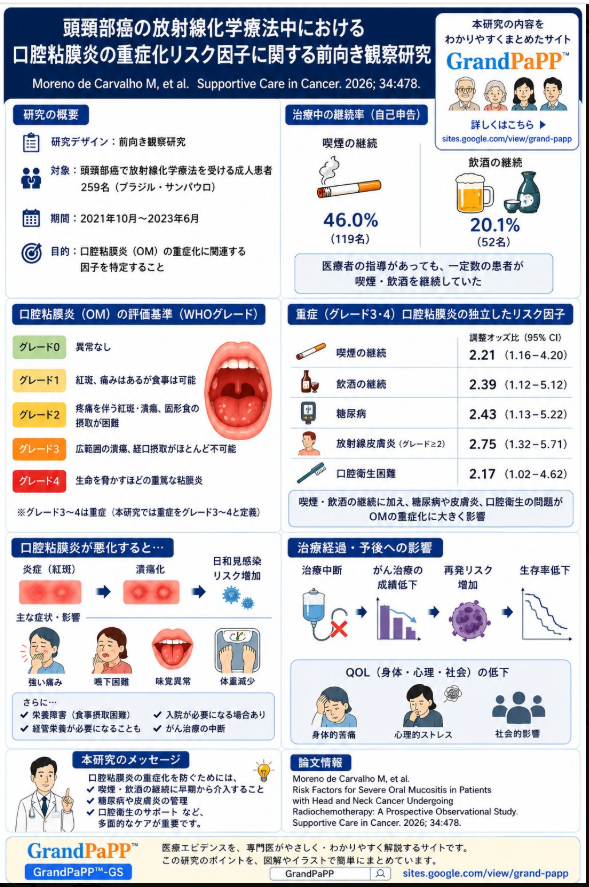
以下、原文リンクと日本語詳細まとめ
口腔粘膜炎
臨床病理学的および生体行動学的因子は、頭頸部癌患者における口腔粘膜炎の発症および重症度に影響を与える
Supportive Care in Cancer. Volume 34, article number 478, (2026)
Moreno de Carvalho M, et al. 原文リンク
※ブラジルの研究(サンパウロ州立大学)
まとめ1
この研究は、頭頸部癌放射線療法中の口腔粘膜炎について、糖尿病、放射線皮膚炎、飲酒、喫煙、口腔衛生困難などが重症化と関連する可能性を示した点で有用です。ただし、RCTではなく、効果量・信頼区間・絶対リスク差・NNTが示されていないため、**診療を変える決定的根拠ではなく、「リスク評価で注意すべき因子を示した探索的研究」**と位置づけるのが妥当です。
まとめ2
明日から適用できるのは、「頭頸部癌RT患者では、糖尿病、喫煙・飲酒、口腔衛生困難、放射線皮膚炎、嚥下時痛がある患者をOM重症化リスクとして注意深く見る」というレベルです。診療を変える決定的根拠ではなく、リスク層別化と観察強化の参考にとどめるのが妥当です。
■ 対象
頭頸部癌患者50例(放射線療法施行、76%が化学療法併用)
■ 何を見たか
放射線誘発性口腔粘膜炎(OM)の
・発症時期
・ピーク時重症度
と、臨床病理・生体行動・人口統計因子との関連
■ 主な結果
・化学療法併用 → OM早期発症と関連
・糖尿病、放射線皮膚炎 → 発症時の重症度と関連
・ピーク重症度と関連
高血圧、糖尿病、軽〜中等度飲酒、放射線皮膚炎
嚥下時痛、口腔灼熱感、口腔衛生困難、オピオイド使用
・重度喫煙 → 口唇部病変と関連
■ その他
・年齢、性別、病期、放射線総線量などは関連なし
■ 結論(事実ベース)
OMの発症と重症化は、
臨床病理学的因子と生体行動学的因子の組み合わせにより
段階ごとに異なる関連を示した