この論文が検索結果に表示された理由となる箇所は、Keyword欄および本文中でハイライト表示されます。
(The content that matched your search query is highlighted in the Keyword section and/or within the article below.)
詳細な論文まとめは下部参照
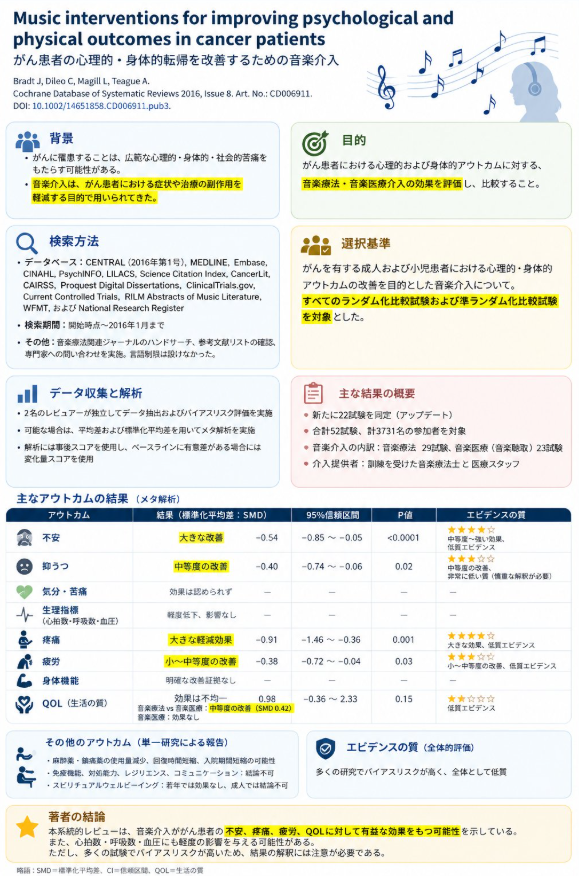
以下の論文中では、
・訓練を受けた音楽療法士が実施する「音楽療法」
・医療スタッフが提供する録音音楽などの「音楽医療」
などに分類されていました。
特に「音楽療法」では、
・個別化
・双方向性
・患者さんに合わせた介入
などの要素が含まれています。
なので、
単純に「生演奏だから効果」ではなく、
「人に合わせて作られる関わり」
も重要なのかもしれません。
—2026/4/9更新————————————————–
「音楽療法の効果」
ちょうど、先週の職場の抄読会でも紹介したのですが、音楽は、すごい可能性があると感じています。
現状、病院、緩和ケア病棟においては、イベント、癒やし、レクリエーション…的な捉え方をされている事が多いと思うのですが、きちんと、効果を評価した論文も存在します。
抄読会で紹介したのは、
「がん患者の心理的・身体的転帰を改善するための音楽介入」、詳細はリンク先に譲りますが、広く論文を集めて評価した結果、
- 痛みに対しては大きな軽減効果
- 不安に対しては中〜強度の改善効果
- 疲労に対しては小〜中等度の改善効果
が示されていました。
特に興味深かったのは、
QOL改善という意味では、録音音楽では明確な改善が見られず、音楽療法士による生演奏などの介入では改善が見られた
とされている点です。
生の楽器の演奏には、弾いている人の聴く人に対する想いや息づかい、空間全体が同時に鳴り響いてくる振動を伴う共鳴感など、ネットでダウンロード出来ない、本物だから伝わるものがあると感じます。
ネットやAI全盛の時代だからこそ、逆に「人を癒やす、人が奏でる演奏」が大事になるのかもしれません。
学問や研究が発展して、携わる人も増えて、数年後には病院での音楽の介入が、標準治療で当たり前になっている時代が来るかもしれません。
ちょうど、今、ご縁のある地元の音楽教室とのコラボで、いろいろな試みを進めていきたいと考えています。
抄読会で紹介した論文内容リンク↓
地元音楽教室↓篠崎ミュージックアカデミー北九州校 ー教室紹介ー
In the following paper, the authors distinguished between:
- “Music therapy,” provided by trained music therapists
- “Music medicine,” such as recorded music provided by healthcare staff
Particularly in “music therapy,” elements such as:
- personalization
- bidirectional interaction
- patient-centered intervention
were included.
Therefore, the benefit may not simply come from “live performance itself,”
but also from
“human interaction tailored to each individual patient.”
“The Effects of Music Therapy”
Fukuoka International College of Music
I happened to introduce this topic at our journal club last week, and I truly feel that music has tremendous potential.
At present, in hospitals and palliative care wards, music is often regarded mainly as entertainment, comfort, or recreation. However, there are also well-designed studies that have properly evaluated its effects.
The paper introduced at the journal club was:
“Music interventions for improving psychological and physical outcomes in cancer patients.”
I will leave the details to the original article, but after broadly reviewing and analyzing many studies, the authors found:
- a large reduction effect on pain
- a moderate to large improvement effect on anxiety
- a small to moderate improvement effect on fatigue
One particularly interesting finding was that, regarding improvement in quality of life (QOL), recorded music alone did not show a clear benefit, whereas interventions involving live music performed by trained music therapists did show improvement.
I feel that live instrumental performance carries something that cannot simply be downloaded through the internet — the performer’s feelings toward the listener, the subtle sense of breathing, and the resonance that fills the entire space all at once.
Precisely because we live in an era dominated by the internet and AI, “music performed by humans, healing other humans” may become even more important.
As research and academic interest continue to grow, and as more people become involved in this field, we may eventually reach a time when music interventions in hospitals become a routine part of standard care.
Right now, through a collaboration with a local music school with whom I have a meaningful connection, I hope to explore various new possibilities together.
Link to the paper introduced at the journal club ↓
地元音楽教室↓篠崎ミュージックアカデミー北九州校 ー教室紹介ー
コメントを残す